
This article provides general information about Swiss payroll costs and employer contributions for educational purposes only. It does not constitute financial, legal, or tax advice. Contribution rates, cantonal regulations, and employment costs vary based on individual circumstances, industry sectors, and legislative changes. Always consult qualified Swiss payroll specialists, certified accountants, or legal advisors before making employment or business decisions. The information presented reflects 2026 regulatory frameworks and may not apply to your specific situation.
When budgeting for a new Swiss hire advertised at 100,000 CHF gross annual salary, planning for exactly that figure guarantees a shortfall. The advertised salary captures just 70-75% of what the employment relationship actually costs your business once Switzerland’s layered contribution system takes its cut.
The gap between posted salary and total employer cost stems from a cascade of mandatory employer contributions that remain invisible until you process your first payroll remittance. According to the social security contribution schedule published by the University of Zurich HR (effective 1 January 2026), AHV/IV/EO alone claims 5.3% of every franc you pay, before unemployment insurance, occupational pensions, and canton-specific charges enter the equation.
Regulatory filings from cantonal compensation offices reveal that first-time employers routinely underestimate total employment costs by 20-30%, primarily by overlooking the compounding effect of age-dependent pension contributions and the near-universal 13th salary convention—neither of which appear in initial salary negotiations.
Your Swiss payroll cost essentials in 4 anchors
- Gross salary covers only 70-75% of total employer cost due to mandatory contributions (AHV/IV/EO, BVG, ALV, LAA)
- AHV/IV/EO (5.3%), BVG/LPP (7-18% age-dependent), ALV (1.1%) form your non-negotiable baseline
- Canton choice creates measurable cost variation: Zug and Zurich differ significantly despite geographic proximity
- Hidden costs (13th salary, collective agreements, training levies) add another 10-15% beyond statutory minimums
Why gross salary represents barely 70% of what hiring actually costs in Switzerland
20-30
%
Typical underestimation margin by first-time Swiss employers on total payroll costs, primarily from overlooked cumulative cantonal variations and the mandatory 13th salary tradition
A Zurich-based technology firm budgets 120,000 CHF for a mid-level software engineer position advertised at 100,000 CHF gross. Finance approves the hire assuming a 20% overhead margin covers all employment-related expenses. Three months into payroll processing, the actual monthly outflows reveal a different reality: the all-in cost approaches 132,000 CHF annually—a 10% budget overrun that compounds across every subsequent hire.
This pattern repeats across Swiss SMEs because the contribution landscape operates on multiple simultaneous tracks. Federal social insurance (AHV/IV/EO, ALV) establishes a baseline that applies uniformly nationwide. Occupational pension obligations (BVG/LPP) then layer on top with age-graduated rates that escalate from 7% employer share for employees aged 25-34 to 18% for those 55-65. Cantonal authorities impose their own payroll-linked charges, creating geographic cost differentials of 8-15% between otherwise identical positions in Basel versus Zug.
The most frequently overlooked cost component is the 13th salary—a near-universal Swiss employment tradition formalized through collective labor agreements across most sectors. Though not federally mandated, this additional monthly salary (8.33% of annual compensation) appears in roughly 90% of Swiss employment contracts, transforming a 100,000 CHF advertised position into a 108,330 CHF contractual obligation before any statutory contributions apply.
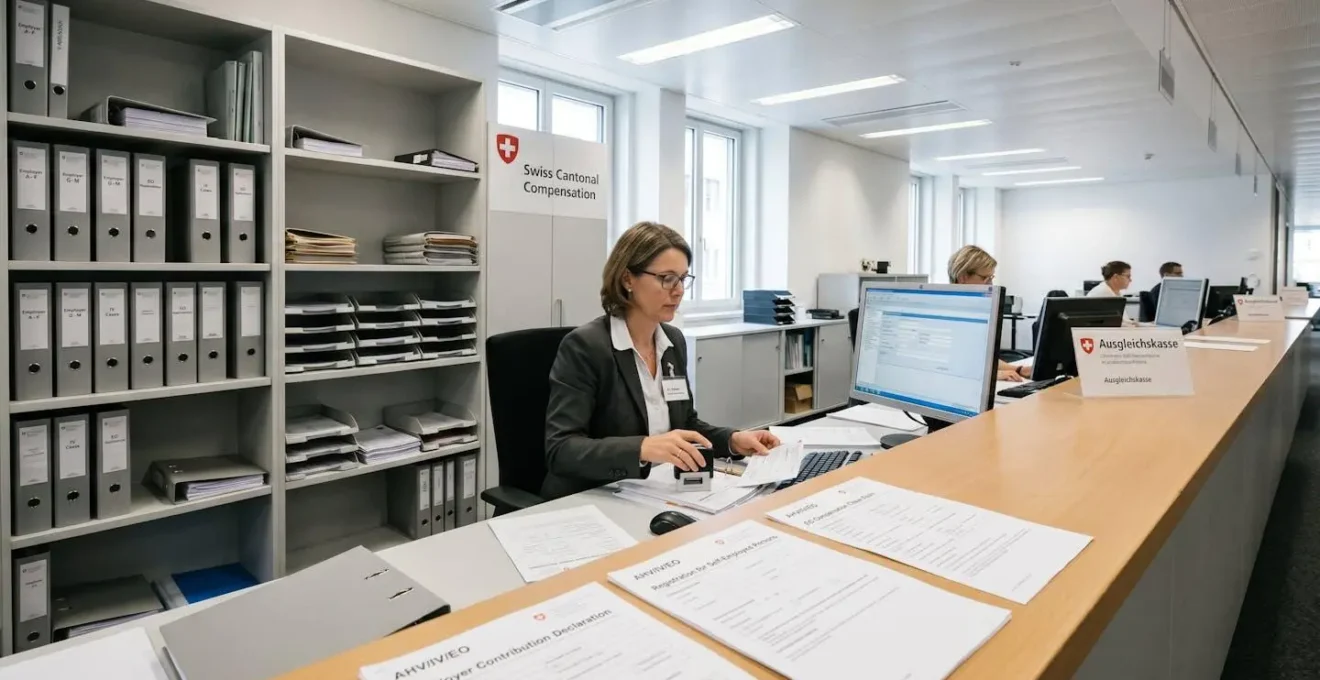
Data from cantonal compensation offices tracking employer registration patterns show that businesses entering the Swiss market for the first time typically discover these layered obligations only when completing their initial Ausgleichskasse (compensation office) enrollment—at which point hiring budgets and workforce plans require emergency revision.
Managing these complex layers of social insurance requires high-precision forecasting to avoid budget overruns. Before finalizing any recruitment process, using a dedicated payroll calculator in Switzerland allows employers to visualize the full scope of their financial obligations. Such tools provide the necessary clarity for human resources departments to align hiring strategies with actual fiscal realities, ensuring that the transition from a candidate’s gross salary to the final employer remittance remains transparent and manageable.
Decoding the mandatory employer contributions that inflate your payroll budget
Switzerland’s social insurance architecture rests on a three-pillar system, with employers bearing direct financial responsibility for the first two pillars. The first pillar (AHV/IV/EO) provides basic old-age, disability, and income compensation coverage. The second pillar (BVG/LPP) funds occupational pensions through mandatory contributions that vary based on employee age and salary level. Understanding these distinct obligation categories clarifies where your payroll budget actually flows once you process monthly remittances.
AHV/IV/EO: The 5.3% non-negotiable foundation
Old-Age and Survivors’ Insurance (AHV), Disability Insurance (IV), and Income Compensation (EO) constitute Switzerland’s foundational social safety net, funded through proportional payroll contributions with no salary ceiling. According to the University of Zurich’s 2026 contribution regulation, employers remit 5.3% of every employee’s gross salary directly to cantonal compensation offices (Ausgleichskassen), matched by an equivalent 5.3% employee deduction.
This 5.3% rate applies uniformly whether you employ a junior assistant earning 45,000 CHF or a senior executive drawing 250,000 CHF—the percentage remains constant while the absolute franc amount scales proportionally. A 100,000 CHF gross salary generates 5,300 CHF in annual employer AHV/IV/EO obligations, remitted monthly or quarterly depending on your cantonal compensation office’s submission schedule.
Occupational pensions (BVG/LPP): The age-graduated cost nobody mentions upfront
Switzerland’s second pillar—the BVG/LPP occupational pension scheme—introduces complexity through age-dependent contribution rates that escalate throughout an employee’s career. The Federal Social Insurance Office confirms that BVG obligations apply to employees earning above 22,680 CHF annually (2026 threshold), with employer contribution shares typically mirroring employee deductions.
Standard BVG contribution schedules operate on four age brackets: 7% combined rate (3.5% employer share) for ages 25-34, escalating to 10% (5% employer) for 35-44, 15% (7.5% employer) for 45-54, and 18% (9% employer) for 55-65. This age graduation means hiring a 52-year-old specialist at 100,000 CHF gross costs your business 7,500 CHF annually in BVG contributions, while an equally compensated 28-year-old generates just 3,500 CHF in pension obligations—a 4,000 CHF annual differential driven purely by age profile.
Unemployment and accident insurance: The finishing touches on your cost baseline
Unemployment insurance (ALV) operates on a dual-rate structure: 1.1% employer contribution on annual salaries up to 148,200 CHF, plus an additional 0.5% solidarity surcharge on earnings exceeding that threshold. The 2026 contribution schedule maintains this ceiling at 148,200 CHF (12,350 CHF monthly), meaning a 100,000 CHF salary incurs 1,100 CHF in annual ALV employer charges.
Accident insurance (LAA/UVG) completes the mandatory contribution spectrum, with premium rates determined by industry risk classification. Office-based professional services typically face 1-1.5% premiums, while construction and manufacturing sectors encounter 2-3% rates reflecting elevated workplace injury risk.
| Contribution Type | Employer Rate | CHF Amount (on 100k) | Authority |
|---|---|---|---|
| AHV/IV/EO | 5.3% | 5,300 | Cantonal compensation office |
| BVG/LPP (age 35-44) | ~5% | 5,000 | Pension fund provider |
| ALV | 1.1% | 1,100 | Unemployment insurance fund |
| LAA/UVG | 1-2% | 1,500 | SUVA or private insurer |
| 13th Salary | 8.33% | 8,330 | Employer (contractual) |
| TOTAL | — | 121,230 | 21% above gross |
Rather than manually tracking these multi-layered contribution schedules across federal and cantonal jurisdictions, employers increasingly rely on specialized tools to automate cost projections and ensure compliance with current 2026 rates across all contribution categories simultaneously.
Important limitations of payroll cost estimates: Calculator estimates reflect 2026 standard rates; canton-specific regulations and contribution percentages may vary. Individual employee circumstances (age, salary level, pension fund choice) affect actual costs. Additional costs such as accident insurance (LAA/UVG), maternity benefits, and collective labor agreement contributions are not universally standardized. Consult a certified payroll specialist or tax advisor for decisions specific to your business situation.
Canton-level tax disparities: Where your office location reshapes the bottom line
Switzerland’s 26 cantons function as independent fiscal jurisdictions, each setting its own income tax multipliers, payroll-linked levies, and family allowance contribution rates. This federalized structure means identical 100,000 CHF gross salaries generate divergent total employer costs depending solely on your office’s geographic coordinates.

The Federal Statistical Office’s 2024 Earnings Structure Survey documents substantial regional wage disparities—gross median wages for management positions reach 12,378 CHF monthly in Zurich compared to 11,697 CHF in the Lake Geneva region. These baseline salary differences interact with cantonal tax variations to amplify total employer cost differentials beyond what salary figures alone suggest.
Zug’s internationally recognized low-tax environment translates to reduced cantonal withholding tax obligations and lower family allowance fund contribution rates (typically 1-1.5% of payroll) compared to Geneva’s 2.5-3% levies. For businesses establishing their first Swiss entity, canton selection represents a one-time strategic decision with permanent cost implications: relocating an existing operation between cantons after establishment triggers complex administrative transfers and potential pension fund changes that most employers avoid.
Payroll specialists commonly recommend that companies hiring 10+ employees within their first Swiss expansion year conduct canton-by-canton total cost modeling before signing office leases. Regulatory trends across cantons show that Vaud and Basel have incrementally increased family allowance contributions over 2023-2025, while Zug and Schwyz maintain more stable contribution schedules—patterns that influence long-term workforce budget projections for growing operations.
The concealed expenses lurking beyond social contributions
Statutory AHV/IV/EO, BVG, and ALV contributions establish the regulatory floor, yet several near-universal employment costs operate in a gray zone between legally mandated and practically unavoidable. First-time Swiss employers encounter these obligations only after hiring their inaugural employee, when collective labor agreements, industry-specific training funds, and cantonal family allowance schemes surface during Ausgleichskasse registration.
- 13th salary obligation (8.33% annual cost, near-universal via collective agreements across most sectors)
- Continued salary during illness or maternity (varies by canton and collective agreement, typically 80-100% for 3-6 months)
- Family allowance fund contributions (canton-specific, ranging 1-3% of total payroll)
- Industry-specific training levies (construction and hospitality sectors, approximately 0.5-1% of wages)
- Collective labor agreement (GAV/CCT) mandatory dues if your sector falls under binding agreements
- Administrative setup costs (compensation office registration, pension fund affiliation, approximately 500-1,500 CHF one-time)
The multi-authority remittance landscape—requiring monthly submissions to cantonal compensation offices, pension funds, unemployment insurance, and accident insurers—explains why automation of payroll tax management has become essential for Swiss employers scaling beyond 5-10 employees. Manual tracking across four separate remittance schedules with distinct submission deadlines creates exposure to late-payment interest charges (typically 5% annually on overdue contributions) and potential cantonal enforcement actions for systematic non-compliance.
Market analysis indicates that businesses handling Swiss payroll in-house for the first time underestimate administrative time requirements by 40-60%, allocating 2-3 hours monthly for what actually demands 8-12 hours when factoring in contribution calculations, multi-authority remittances, and regulatory change monitoring. This time burden explains why fiduciary services (Treuhand providers) handle payroll for roughly 70% of Swiss SMEs with fewer than 20 employees, despite service fees of 80-150 CHF per employee per month.
Questions employers ask before calculating their first Swiss payroll
When are employer contributions due to Swiss authorities?
AHV/IV/EO and ALV contributions are typically remitted monthly or quarterly to cantonal compensation offices, with deadlines varying by canton (usually 10-30 days after period end). BVG contributions follow pension fund-specific schedules, often monthly. Each authority issues its own payment deadline, meaning a single payroll cycle triggers 3-4 distinct remittance obligations across different calendars.
What penalties apply if I miscalculate or delay contribution payments?
Late or incomplete contributions trigger retroactive interest charges (typically 5% annually on the outstanding amount) and potential administrative penalties. Systematic non-compliance can result in enforcement actions by cantonal authorities and, in severe cases, prosecution under social insurance regulations. First-time minor delays usually generate interest charges without additional penalties, but repeated violations escalate enforcement responses.
Can I legally reduce payroll costs in Switzerland?
Statutory contribution rates are non-negotiable and apply uniformly within each category. Legal optimization focuses on canton selection for new establishments (before office location is fixed), accurate employee classification to avoid over-contributions, and pension fund provider comparison within regulatory limits. Tax-deductible expense structuring and benefits package design require professional guidance to ensure compliance while optimizing total compensation costs.
Do all employees trigger the same employer costs?
No. BVG contributions increase with employee age (7% combined rate for 25-34 year-olds, up to 18% for the 55-65 bracket), meaning identical gross salaries generate different total employer costs based solely on birth date. Part-time employees earning below 22,680 CHF annually are exempt from BVG obligations. Foreign workers on B or L permits may be subject to withholding tax (Quellensteuer) with different administrative processes than standard payroll.
Should I handle payroll in-house or outsource to a fiduciary?
First-time Swiss employers typically benefit from fiduciary services (500-1,200 CHF monthly for small teams) to ensure compliance and avoid costly errors during the initial 12-24 months. In-house payroll becomes cost-effective at 15-20+ employees with dedicated HR resources and Swiss payroll expertise. The decision threshold balances service fees against the risk cost of miscalculation penalties and the opportunity cost of senior staff time spent on monthly remittance processing.
How do Swiss payroll obligations compare when expanding from other European markets?
UK or EU-based companies establishing their first Swiss entity face not only these payroll obligations but broader fiscal integration challenges—explored in our guide on navigation of business taxation in Europe. Switzerland’s three-pillar system and cantonal federalism create administrative complexity exceeding most EU member states’ centralized social security frameworks, requiring specialized guidance for cross-border employment structuring.